


The university says no conference invitation was ever received. The coach, Grant Leeth, who built the program says one was close.
What started as rumblings on social media turned into a full-blown public dispute over the past 24 hours, with Tarleton State University, its president, and the man who built its wrestling program from scratch all issuing statements that paint very different pictures of what happened behind the scenes.
President Dr. James Hurley outlined what he described as a clear five-year plan established at the club’s launch, one that prioritized participation, retention, graduation, and sustained funding before any DI consideration.
In Hurley’s view, the program is still too early in that timeline to evaluate.
The short version: Tarleton State wrestling is staying a club sport. There are no plans to move to NCAA Division I. And head coach Grant Leeth, who volunteered his way into building a nationally competitive program in just two years, is out.
How We Got Here
Tarleton State launched wrestling as a student-led club sport in 2023. Under Leeth’s guidance, the program grew quickly. A $1.4 million wrestling facility was built. More than 54 student-athletes committed early on. The women’s team won NCWA national titles. The men placed in the top three. The club competed against established DI programs including Oklahoma, Duke, and SIUE, and brought in what Leeth described as record official visits.
The widespread expectation, fueled in part by the program’s rapid trajectory, was that Tarleton was on a path to transition from club to NCAA DI. Leeth says that belief wasn’t unfounded.
“We were in deep conversations with a major conference late last year,” Leeth wrote in a public statement on The Wrestling Room. “The coaches voted to bring us in, and there was real momentum. I was led to believe that if we could make a conference happen, we would make the transition.”
But according to Leeth, when calls were made to the Tarleton administration to move things forward, they were met with silence. He acknowledged that, technically, no formal offer was ever extended from a conference, but made clear the conversations were real and progressing.
The University Pushes Back
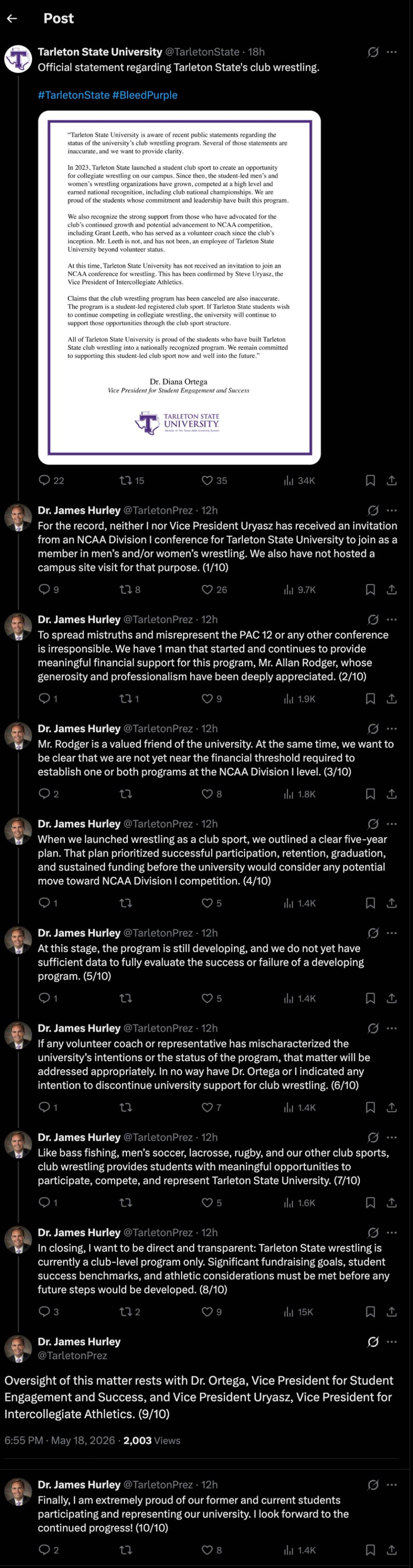
Tarleton responded with an official statement from Dr. Diana Ortega, Vice President for Student Engagement and Success, calling recent public claims about the program “inaccurate.” The statement emphasized several points: the program is and always has been a student-led club sport, Leeth was a volunteer coach and not a university employee, and Tarleton has not received an invitation to join an NCAA conference for wrestling. Steve Uryasz, the Vice President of Intercollegiate Athletics, confirmed as much.
The university also pushed back on claims that the program had been canceled, stating that if students wish to continue competing in collegiate wrestling, the club sport structure will remain available.
TSU President Goes on the Record
President Dr. James Hurley took the unusual step of addressing the situation directly in a lengthy thread on X (formerly Twitter), and he did not mince words. Hurley stated that neither he nor VP Uryasz received a conference invitation, and that no campus site visit for that purpose had taken place. He called it “irresponsible” to misrepresent the Pac-12 or any other conference’s involvement.
Hurley acknowledged one key financial supporter, Allan Rodger, calling him “a valued friend of the university,” but stressed the program is not yet near the financial threshold required to establish NCAA DI wrestling.
President Dr. James Hurley outlined what he described as a clear five-year plan established at the club’s launch, one that prioritized participation, retention, graduation, and sustained funding before any DI consideration. In Hurley’s view, the program is still too early in that timeline to evaluate.
Perhaps the most pointed remark: “If any volunteer coach or representative has mischaracterized the university’s intentions or the status of the program, that matter will be addressed appropriately.”
Hurley closed by expressing pride in the students and reaffirming the university’s support for club wrestling, while making clear that significant fundraising goals, student success benchmarks, and athletic considerations must be met before any future steps would even be developed.
Reading Between the Lines
There are two stories being told here, and neither side is being entirely unreasonable.
Leeth built something real and did it fast. A $1.4 million facility, national titles, and head-to-head competition with DI programs is not a typical club sport trajectory. When a conference’s coaches vote to bring you in, it is not a stretch for the person running the program to believe a transition is coming.
On the other side, the university is drawing a clear line between informal conversations and formal commitments. No offer was extended. No invitation was received. And the five-year plan, at least from the administration’s perspective, was always the governing timeline.
What seems clear is that a disconnect developed somewhere between the wrestling room and the administration building. Leeth says he told recruits, parents, and donors the truth as he understood it. The university says those representations were inaccurate. Families who may have made decisions based on the program’s rapid trajectory now face uncertainty about what comes next.
Leeth, for his part, left with class. “No animosity from our end,” he wrote. “Things change, stuff happens, and you just have to roll with the punches.”
The club will remain an option for Tarleton students who want to wrestle. What it looks like without the coach who built it is another question entirely.
Will you send your wrestler to Tarleton State University?